


I live by the Aegean Sea now. I’ve had to work hard to switch my terminology from “ocean view” to “seaside”. Working hard is such an exaggeration. It takes effort that I don’t feel. I usually misspeak and someone corrects me that actually, Alissa, you are looking at the sea.
Izmir is the third-largest city in Turkey. When I said I was going to Turkey for three months, people responded in three ways: with questions, with comments, and with concerns. Questions were, “Oh! What will you be doing there?” Comments were, “Oh wow! That’s going to be amazing!” And concerns were, “Aren’t you afraid you’re going to get kidnapped? You’ve seen Taken, right?” No, actually. Never have I ever. In all seriousness. But I’ve heard that “particular set of skills” quote enough.
Both Turks and Americans are a bit stumped by my answers: I’m here for fun. There isn’t a job here. There isn’t a man here (But there certainly are men. Beautiful men. Walking down the street is pure delight for the eyes). I teach English online and I’m a graduate student online as well, and so I can currently do those things anywhere. Why not here?
Turkey came on my radar through a few of my ESL students. Turkey is literally the bridge from Europe to The Middle East, and it’s kind of like the kid who was born in one country and raised in another: sometimes they feel like they belong to two places, and sometimes they feel like they belong to neither one. I’ve been interested in The Middle East for a while now, particularly Iran, but I have had some of the loveliest Turkish students, and they made me curious about their culture, their language, their country. So I decided to come.
I’m a social Painted Lady: making friends is not a difficult feat for me. I love people. I mean, I love people. I want to go to all the corners of the earth and find them. This is actually my main reason for traveling. To be able to say I’ve seen Mount Fuji or Niagara Falls is great, and viewing grand creations like that changes you on the inside. To have had gelato in Italy and to have performed at The Waterfront in both Cape Town and Belfast have filled my soul. But my greatest love for traveling is because of people. I want to learn to see the world through their cultural lenses, to learn their dances and try their words on my own tongue. I want to share meals with them and put their clothes on my body and look at their skies alongside of them. This is where my greatest transformation takes place: in beholding the eyes of another.

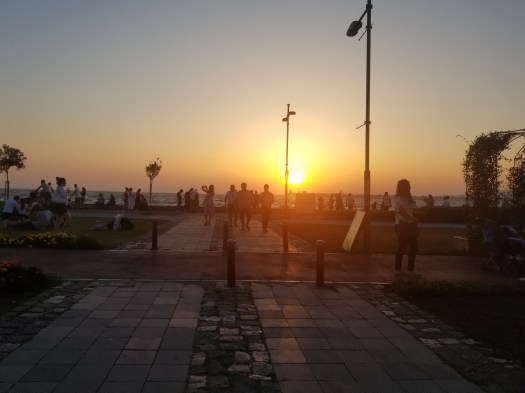
I, the Painted Lady – the social butterfly – on my second night, take a stroll along the kordon. It’s not quite like anything I’ve seen before. The sea I live by is walled, not beached. And Izmir has paved bike paths and walking trails and planted flowers along the sea. They’ve made it kind of like a mile-long park. And this is why I belong here: these people are night owls too. Not morning people. They fill the kordon at night, bringing their cigarettes and their alcohol and their friendships. They stay there until the sun rises, sometimes. Children play on the play sets until 2 in the morning.
As I’m walking, I see the grass littered with some kind of shell, and I’m not sure what it is. Nearby, there’s a group of three young men rapidly eating the seed held within those shells. It turns out their sunflower seeds are white and longer and thinner than ours, and they are perhaps the most popular snack in this area. I peer at the guys to see how they’re doing it, so machine-like in the way they crack the cases with their teeth, simultaneously catching the seed in their mouth and discarding the shell. They see me, and I unknowingly stumble upon the person who will become the sweetest gift this city could give me: Yasir.
Waving me over, I join them and watch them eat the Çiğdem. They offer a handful to me, and failing pretty miserably at opening them, we laugh. Yasir is sitting on the far left, and as an electrical engineering student, he has had to learn English, though it’s hard to practice here when you have no one to speak with. I’m probably the first American he’s met. He asks me questions and translates for everyone. I’m 29 years old. I’m from California. Yes, marijuana is legal there. I’m here for fun. I’m here for three months. Thank you, but no, I don’t want a cigarette.
The other two leave to get more beer, and Yasir stays with me. He doesn’t look like what I think a Turk would look like. I expected them to resemble their Iranian neighbors more, and some of them do. But Turkey is colorful in every way. Yasir has brown hair, and he looks like a cross between Zac Efron and a friend from back home. Like most people here, his default disposition is serious, focused, and intense. He laughs, and his face breaks into a thousand delights, and I wonder why he doesn’t keep them there. He has holes in his t-shirt, and I have yet to tell him that if he travels to America, he’s going to get mixed feedback on the crocs he’s wearing. His eyes are unexpectedly blue: lighter than the sea and darker than the sky at midday.
He asks me what I see in Turkey, and I say that I see people together. In America, I tell him, we spend a lot of time alone. We sit alone and we eat alone and we spend a lot of time on our phones. Perhaps we are overwhelmed, or perhaps we are just independent. We are not always lonely when we are alone, but sometimes we are both.
I live so much of my life alone. I go to Disneyland alone and I show up to events alone. I have gone to movies by myself and I fly around the world solo. Rarely do I feel lonely. Sometimes, it feels easier to be solitaire, faster and more convenient. Every time I go to Trader Joe’s, I silently am grateful that I don’t have kids yet. Because shopping can be nearly impossible with children.
I don’t eat out alone though, and I tell him this. That feels lonely and sad to me. He shares that in Turkey, it’s not good to be alone. That’s why you have friends. It’s really uncommon for people to be alone. They walk down the street in twos and threes, they sit on the grass in groups. Sometimes they’re not even doing anything – they’re just being together.
He asks me why we are alone so much, and I tell him this: for Americans, we inwardly believe that being alone is a sign of strength, of independence. If you can do it by yourself, you are strong. Or you are brave. And I share with him that, perhaps, I believe that too. That for me, coming to a country where I don’t speak the language and a city where I don’t know anyone was, in a way, an opportunity to be brave. Maybe, for me, it’s really a way to become brave.
His response is why I love teaching English as a second language. When English is a second language, people see it from a different perspective, and often, the way they combine words has this beautiful angle to it. When I hear these new expressions, I am changed. And I crave those changes.
Yasir says, “You are great brave.”
It should be “very brave”. I recognize this. But “great brave” implies an extraordinary amount of bravery. It would take at least three “very’s” to become great. And the truth is, I feel great brave. I feel very, very, very brave.
 The Merry Old Soul